Take a moment to recall what you were doing on November 14th three years ago. Most of us hit a cognitive blank wall. We cannot query our brains like an SQL database indexed by timestamp.
Now imagine hearing a faint jazz tune from that narrow attic café in Florence, smelling roasted chestnuts after a sudden autumn drizzle, and seeing an espresso cup with a chipped edge. Instantly, the floodgates open: who was sitting across from you, what dreams you were debating, and how you felt in that exact season of your life.
"Episodic memory does not store timestamps; it weaves tapestries of spatial coordinates, sensory impressions, and human connections."
1. The Illusion of the Performative Feed
Modern society has spent fifteen years outsourcing our memories to public feeds. We post vacation photos to Instagram, career milestones to LinkedIn, and witty remarks to X.
Yet these repositories do not serve our genuine self-reflection. They are curated for an invisible audience, optimized for likes, retweets, and social signaling. When you look back at an algorithmically ranked feed, you aren't recalling who you actually were—you are inspecting a PR archive of who you wanted other people to believe you were.
2. The Power of "On This Day" as a Temporal Mirror
This is where the psychological magic of "On This Day" comes alive. When implemented with reverence and privacy, an anniversary flashback acts as a gentle temporal mirror.
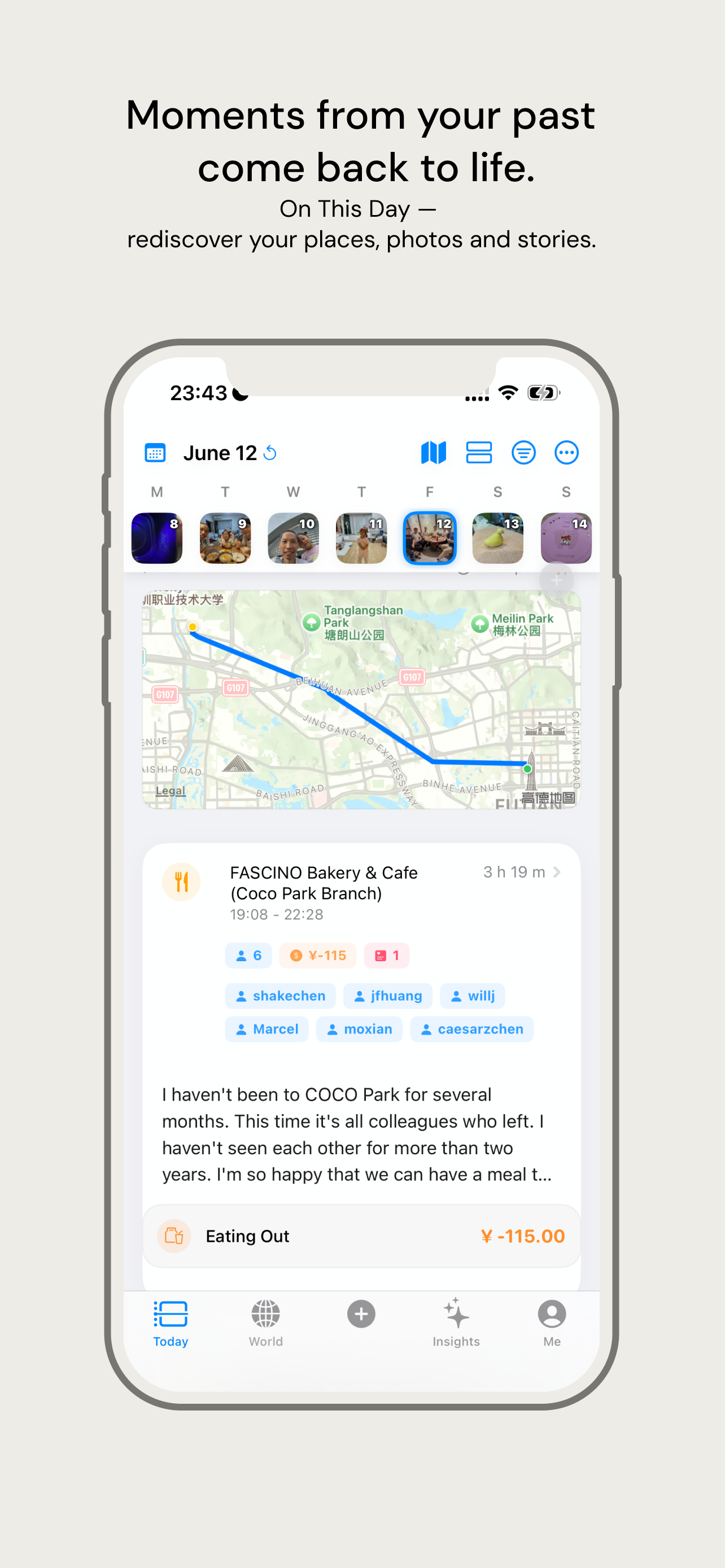
In Ousia, the "On This Day" card does not judge your progress or calculate productivity scores. It quietly presents a synchronized triad:
- Where you stood: The exact geographic pin and the route you walked that afternoon.
- What grounded you: The modest expense recorded at the corner bakery.
- What caught your eye: The candid photo captured at that very coordinate.
3. Why Connected Data Evokes Emotional Resonance
A single number—like "Spent $45 on Oct 8th"—is sterile data. A single GPS point—like `48.8566° N, 2.3522° E`—is machine telemetry. Neither carries emotional warmth.
However, when these disparate threads intertwine into a connected life graph, qualitative magic occurs:
"Two years ago today, you spent 2 hours and 15 minutes at Shakespeare and Company in Paris, paid €18 for a second-hand poetry anthology, and took a photo of the golden afternoon light spilling over the Seine."
This isn't an accounting record; it is an emotional anchor. It reminds you of your trajectory, softens the anxieties of current setbacks, and proves that every ordinary day holds an irreplaceable spark.
4. Calm Technology: Recording Without Noise
For memory tools to cultivate authentic mindfulness, the technology itself must remain radically calm. Mark Weiser's pioneering vision of Calm Technology reminds us that tools should inform without demanding our continuous attention.
Ousia adheres to three non-negotiable architectural convictions:
- No Public Stream: No follower counts, no comments, and no public vanity metrics. Your timeline belongs entirely to you.
- Zero Cloud Profiling: Everything stays 100% on-device and local-first. We cannot read your memories, analyze your routines, or sell your coordinates to ad brokers.
- Passive Capture: The spatial skeleton tracks effortlessly in the background, freeing your conscious mind to live the moment.
Reclaiming Your Life's Essence
In ancient Greek philosophy, Ousia (οὐσία) signifies the true inner essence of things—the fundamental reality beneath transient appearances.
Your life is not defined by the notifications pinging your screen or the checkboxes completed on a corporate backlog. It is shaped by the places you touched, the relationships you nurtured, and the quiet moments you experienced. Let your phone serve as a faithful, silent biographer.
Build Your Private Life Archive
Revisit "On This Day" memories with spatial coordinates, candid moments, and zero cloud profiling.
Get Ousia on the App Store