Imagine coming home after a grueling twelve-hour day. You commuted across the city, met with three clients, squeezed in lunch at a small deli, picked up groceries, and attended an evening workout class.
You collapse onto your sofa. Your phone buzzes with a reminder from your habit tracker: "Time to fill out today's journal and log your expenses!"
You open the app. Staring back at you is a cold, blank text field and twelve category dropdowns. What time did you leave the client's office? How much did that cab ride cost? What was the name of the cafe where you took that critical call?
Your brain, already exhausted from making decisions all day, experiences what behavioral psychologists term cognitive logging friction. You swipe the app away. Two days later, you miss another log. By the end of the week, the entire system is abandoned.
The Paradox of the Blank Spreadsheet
Most productivity and journaling apps make a fatal architectural assumption: they assume that humans enjoy data entry. They hand you an empty database and expect you to act as an unpaid clerk of your own life.
"A tool that demands your active labor for every mundane detail will always be abandoned the moment life gets busy."
Yet the desire to remember remains universal. We yearn to look back and see how our time was spent, where our money went, which places shaped our routines, and how our habits evolved. The problem was never the desire—it was the mechanism.
The Two-Layer Architecture: Skeleton & Soul
To build a personal life system that endures for years rather than days, we must invert the relationship between effort and capture. In our design of Ousia, we established the Two-Layer Principle:
Layer 1 (The Passive Skeleton): Your phone already knows when you moved, where you paused, which photos you took, and which transactions were processed. This objective spatial skeleton should be captured with 0 taps in the background.
Layer 2 (The Intentional Soul): You only spend active attention on what truly matters: who you were with, what you ate, or a fleeting reflection. One tap on the generated timeline is all it takes.
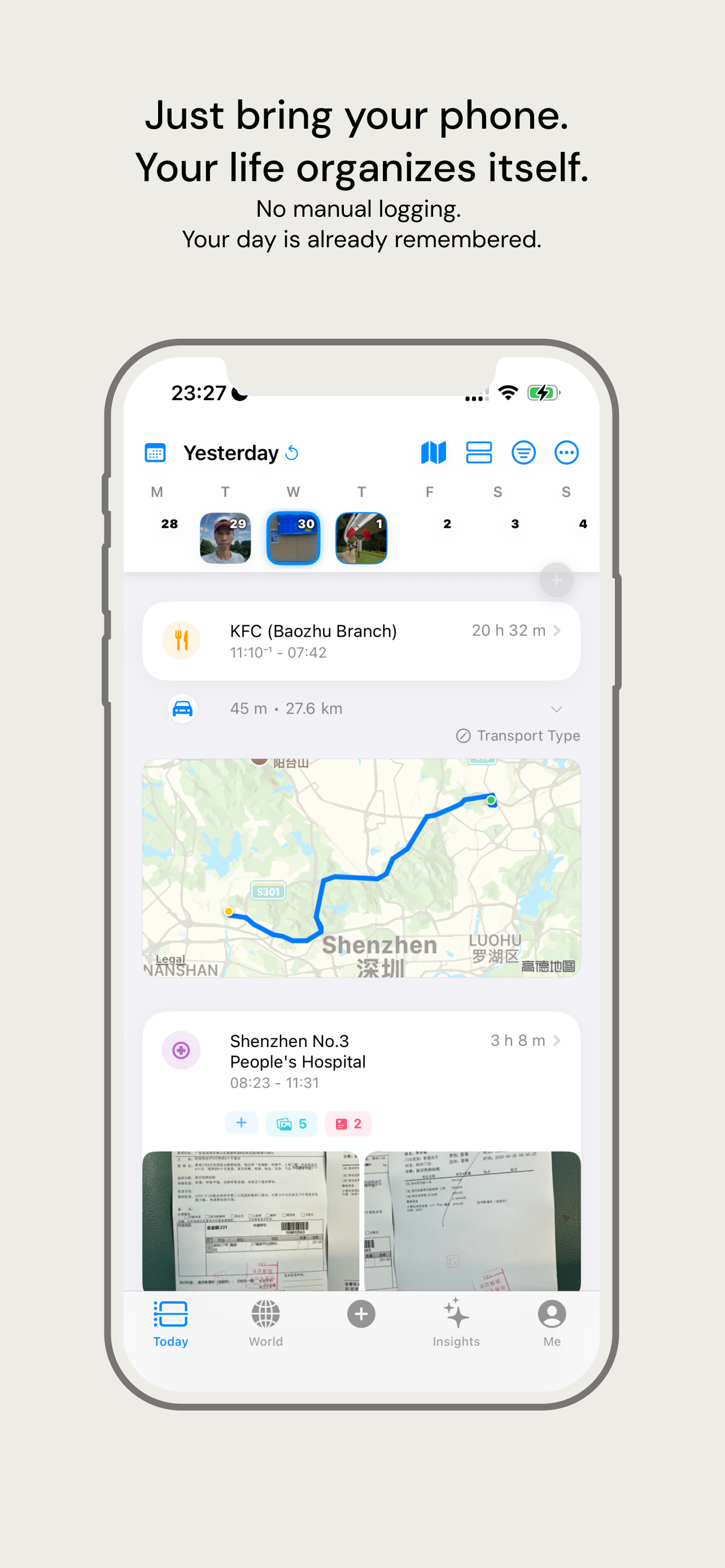
1. Trajectory Smoothing Without Battery Drain
Earlier generations of lifeloggers (such as the beloved Moves app from a decade ago) suffered from catastrophic battery drain. Running standard GPS continuously would drain an iPhone battery in under six hours.
Modern spatial engineering solves this through Adaptive Duty-Cycling. By utilizing Apple's hardware Significant Location Change (SLC) APIs and onboard motion coprocessors, the GPS hardware enters deep hibernation whenever you sit at your desk or relax in a coffee shop. High-precision sensor fusion only wakes up when physical displacement actually occurs.
2. Linking Spending to Physical Space
Traditional expense tracking fails because it dissociates money from physical context. A row stating "$-14.50 Dining" tells your brain nothing six months later.
When transaction imports are matched against your spatial timeline, the entry transforms: "$-14.50 at Blue Bottle Coffee on 4th Street, while meeting David." The expense ceases to be dry accounting; it becomes a milestone in your life story.
The Compounding Value of a Connected Life Graph
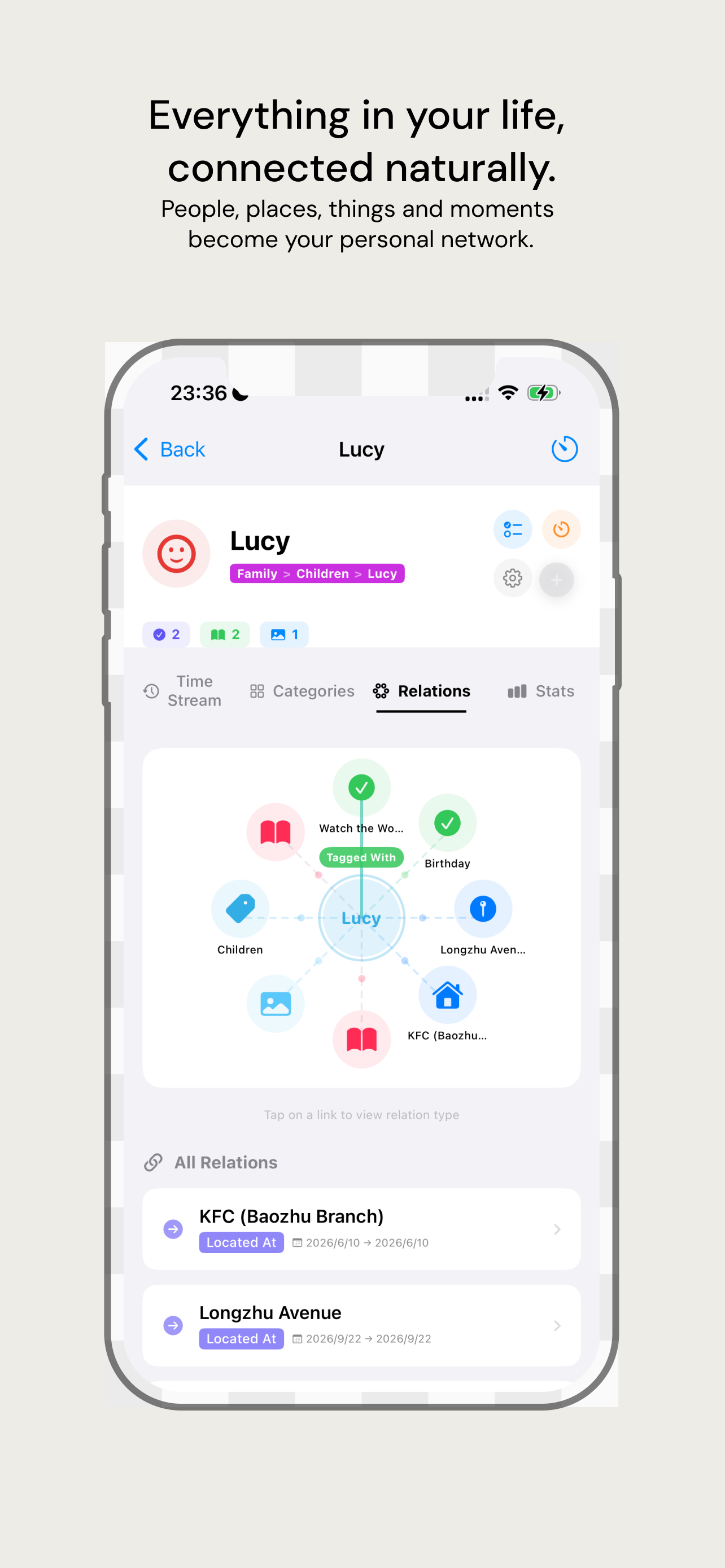
When people, places, photos, workouts, and expenses are connected into a unified local database, magic happens over time.
On a Tuesday morning one year from now, your dashboard surfaces an "On This Day" capsule: the photos you took, the hidden ramen shop you discovered in Tokyo, and the notes you scribbled down. You didn't spend thirty minutes writing an essay that night—the system synthesized it for you while you lived your life.
Build Your Living Life System
Experience the calm power of passive spatial tracking and private, local-first memory capture.
Download Ousia on the App Store